Posts

Parenting With Steiner/Waldorf in Mind (and questions to ask).

Like so many new parents, I have found myself researching parenting trends and the science of child-rearing. Why not share? During interviews conducted during my graduate studies with experts on experiential learning there was commonly a referral like: "Well if you look at the utopian experience that Steiner/Waldorf Schools advocates create...". The expert would go on painting a description of a learning style striving to develop a complete human being. Where music, movement and theater, writing, literature and nature are not simply subjects to be read about and tested. They are experienced. The skinny: a Steiner/Waldorf ethos demands questioning of an experience or reaction to a behavior. What could be some nuggets that parents could utilize in home life? This post is just some Q and A's whipped together. Is electronic media as bad as research says it is for children? [1] Yes, Steiner/Waldorf training programs argue. Electronic Media affects child development ...

In the air

As blogging and sharing professional reflection evolves, my energies currently exist on twitter and with the following sites This blog is on a hiatus and will be updated as the fresh classroom changes along with the seasonal wheel. CBE Integration and Environmental Service Unit  Paul Kelba on twitter CBE Sustainability

"Talk is Cheap": Reflections on North Face founder Doug Tompkins in the Wake of Paris Climate Talks

Image
"Find your place on the planet. Dig in, and take responsibility from there,"[1]  Gary Snyder Environmental issues, in particular climate change, were splashed over international press during this month's Paris climate talks. This gathering, attended by all major heads of state, is based on the assumption that each country will independently, voluntarily lower their carbon footprint. [2] The problem with the assumptions coming out of Paris is when push comes to shove, will governments receive enough pressure from its citizens to voluntarily lower carbon footprints? Enter Douglas Tompkins, a true Earth Hero, died this month.  Doug walked the talk of a caring steward of the natural world. His priority was ensuring citizens of the planet have a connection to the natural world in order to take care of it and "pay the rent of living on this planet" Best to let him do the talking, videos and quotes are below. Rick Ridgeway wrote eloquently of his passing in...

The Best Summer School is Free Play

Image

Emotions and Environmental Education

Image
I adore my 'Google alerts' that greet me every morning in my inbox. It's a simple stream of collected items on a specific topic, the standing tags include everything from environmental education and ecological education, to experiential education and maker education. I know, I know, email updates? How archaic, with the fact that it is twitter leading the improvement of the profession of teaching with its quick and easy exchange of content and collaboration. However, the 'Google alerts' extend farther than the twittersphere with a diverse hodgepodge of studies, news releases and international lens to many resources that do not appear on twitter immediately, if ever. News in the alerts features programs mostly centering on ecology, concerned with connections to the curriculum and local natural areas, as well as grant programs and studies. Great food for thought, highly recommended for any of you wanting a finger on the pulse. Enter...

Kurt Hahn's contribution to a vision of education [graphic]

Image
Info-graphic for this week's #EnviroEd twitter chat

Where does tech fit in environmental education?

Image
A daily scan of the twitter feed lead me to a Mindshift post titled: Apps that challenge kids to solve environmental issues  Yes! I thought, solving environmental issues with technology, how timely is that?  The gravity of this hit me, Environmental Ed, interpreted in the form of an innovative learning technology, posted on a world class progressive public website. (NPR Mindshift) I initially wanted to spread the word on these apps, repackage them and post to followers who seem to respond to content that mixes old with new nuggets of best practices. Not a chance. These apps not only contribute to a 'Disneyfication' of nature, apps like Enercities and Little Green Island present environmental problems and when the game player simply balances natural resources, they succeed. Along with a cheap feel of empathy. Of all the amazing ways tech can enhance students relationship with the natural world, these are thin. Students need to be feeling alive, lead to joy and won...

Drones in Schools-The Latest 'Pilot' Program

Image
Our objective of using drones in the classroom, with help from a recent educational grant, is creating motivation for learning, stem fields in particular. The short list of learning content results was robotics, modelling and simulation as well as photography and connection with our natural world. An in-demand technology, with skills connecting to a variety of industries. Other factors that lead to some success were a loan program where students could work towards obtaining a school 'licence' where they were given the autonomy to sign out a drone a take it home to extend their skills, not surprisingly there was no problems with this. We rounded out the pilot with a mentorship program for the grade 8's and 9's with high school robotics/multimedia students to repair devices and design more sophisticated units, using Gimble's for a variety of projects this upcoming year. The lead students of our program documenting grade 9 grad was a highlight: ...

Don't believe everything you hear about summer learning loss-Updated

Image
This is an updated version of an article of mine for parents during summer that originally appeared two years ago.  Wishing you a wonderful and safe yet adventurous summer 2014. Paul @paulkelba If summer memory loss exists, the students that I teach in a public school are more than capable of overcoming it. Students that return in September that demonstrate notable social and emotional growth are those best  equipped  to handle technical problem based learning in schools, not  necessarily  the students that master the latest math application, attend a typical summer school program or bring a textbook home for summer. As a teacher faced with questions from parents of: "How can my child avoid falling back during the summer break", many times have found myself steering students towards a summer of consumption. Last year I promoted terrific learning app's, and in previous years comprehensive websites, summer academic programs and such. It always seemed a reg...

Revisiting A Critical Pedagogy of Place

Image
Stepping outside of the classroom is an underrated way for a school to allow students to grow as a citizens. How do we do it with purpose? During the informal Jim Mathews video (below) on place-based education , he challenges us to embrace the current 'new localism' trend in local goods and produce, micro-enterprise, car sharing etc...a: "diverse act of resistance against homogenization and mass-consumerism." I appreciated the examples he uses, taking classes into the community, an edge into education, one of self-reliance. Mathews takes education researcher David A. Gruenewald's ground-breaking article    A Critical Pedagogy of Place  and gives tangible examples for students growth and well being. Moreover, he highlights student agency that is able to steer teachers away from pushing their own agenda, a common problem (mostly perceived) but so important to be mindful of. We all need reminders (myself especially), Gruenewald cal...

More Q's than A's: Place-based Learning Page for EdCampYYC

Image
Place-based learning is a holistic approach to education, conservation and community development that uses the local community as an integrating context for learning at all ages. A main goal is to foster vibrant relationships between schools and communities to boost student achievement and to improve communtity health and vitality. Three parts for educators reference: 1-Guiding questions 2-A few examples 3-Ammunition... Guiding Questions What needs to be created in this place? What needs to be restored in this place? What needs to be transformed in this place? What needs to be conserved in this place? Jim Mathews' Q's to begin your community research A's: What should the content focus on? Values about  what What should the actions and interactions look like? Values about  how Why is place important? What are the goals? Values about  why Why "care about" and "care for" the local? Who gets to answer these questions? Values abo...

Slideshare of Outdoor Learning PD Day 2014 -Paul Kelba CBE-

My presentation for Outdoor Learning educator workshop : ...concerning mobile devices and Environmental Education, here's a previous ISTE session: What's Your ECOpedagogy?

Moral and intellectual courage only comes from experience

Image
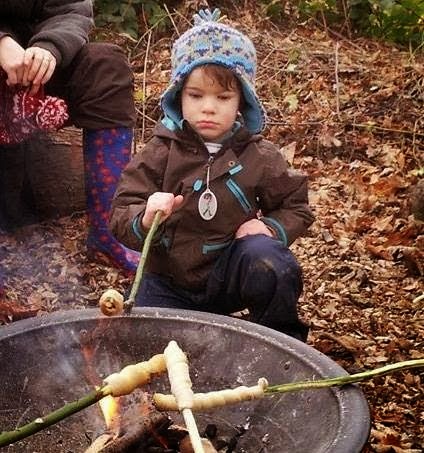
"Moral and intellectual courage only comes from experience" J. Darling I just read a piece about 2 and 3 year olds cooking over a fire. Author Emma Conder summarized the essence of experiential education in one picture and about four paragraphs. 'Sam with his damper bread' Emma Conder The simplicity of this strikes me. Yup, it's all there, the process of understanding, information transfer. The concrete experience and reflection stage is occurring simultaneously, this child is no doubt set for success to conceptualize this in the near future. Ms. Conder calls it 'ignighting minds'.  Makes one curious how large school districts embrace this and at older ages. 'Bushcraft' and outdoor education experiences (most importantly overnight ones) almost entirely remain as extra-curricular activities and appear as enhancements to a schools program. If a school/districts vision revolves around interacting with experiences and buildi...